
Port
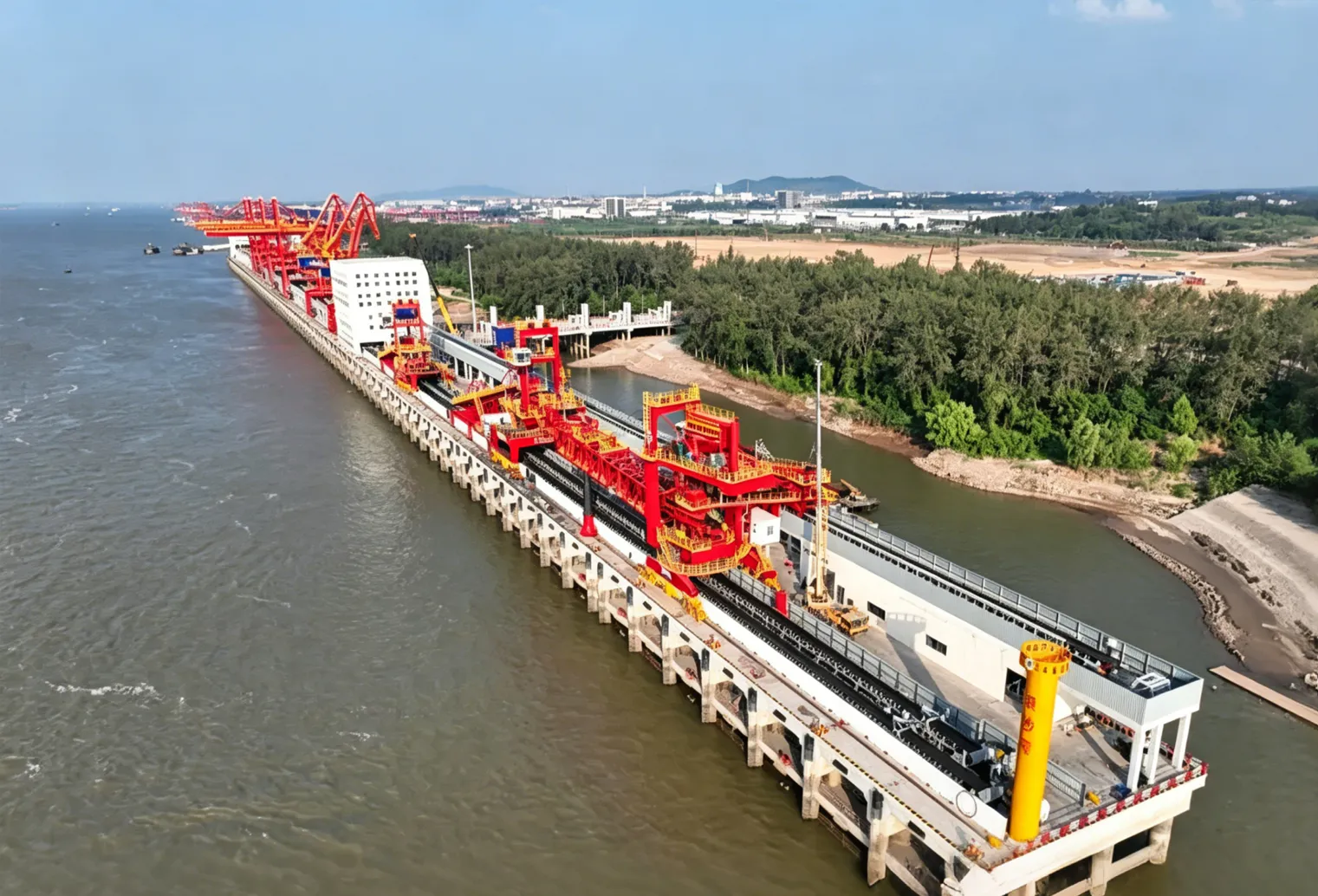
Terminal complet de Jiujiang Yinshawan, province du Jiangxi
Le terminal polyvalent de Yinshawan à Jiujiang est situé dans la ville de Liusi, comté de Hukou, Jiujiang, province du Jiangxi, sur la rive droite de la section d'entrée du chenal rectiligne nord-est du cours moyen et inférieur du fleuve Yangtsé (116,391100° E, 29,846803° N). Il s’agit d’un port de jonction majeur aménagé par la province du Jiangxi et constitue la zone fonctionnelle centrale de fret en vrac dans le dispositif « un port, cinq zones » de Jiujiang.
D’un investissement total de 2,681 milliards de yuans, le terminal occupe une superficie foncière de 613,3 mu, avec une longueur de rivage planifiée de 820 mètres. Il comprend six quais pour navires de 5 000 tonnes dédiés au fret en vrac, tandis que les ouvrages hydrauliques sont également conçus pour accueillir des navires de 10 000 tonnes. Sa capacité de traitement annuelle est de 22,8 millions de tonnes ; il assure principalement le chargement, le déchargement et le transbordement de marchandises en vrac telles que le charbon et le minerai. Il joue un rôle majeur dans l’optimisation de la structure de transport multimodale régionale intégrant la voie d’eau, la route et le chemin de fer.
L’objectif principal de ce projet est de garantir une « interruption zéro et retard zéro » du réseau de communication lors d’urgences majeures, telles que les phénomènes météorologiques convectifs violents, les collisions de navires, les incendies et les fuites de marchandises en vrac. Le système est conçu pour permettre un commandement unifié et une répartition précise à travers plusieurs services et échelons de gestion, assurant la sécurité des opérations portuaires et une coordination efficace des secours d’urgence. Situé sur un chenal maritime stratégique du cours moyen du Yangtsé, le terminal évolue dans un environnement dynamique et complexe. Les conditions extrêmes telles que les hautes eaux en période de crue, les températures élevées et l’humidité estivale, la corrosion par la brine saline, les obstacles causés par les stocks de vrac et la densité du trafic maritime imposent des exigences strictes en matière de stabilité, d’immunité aux interférences et de durabilité des équipements de communication.
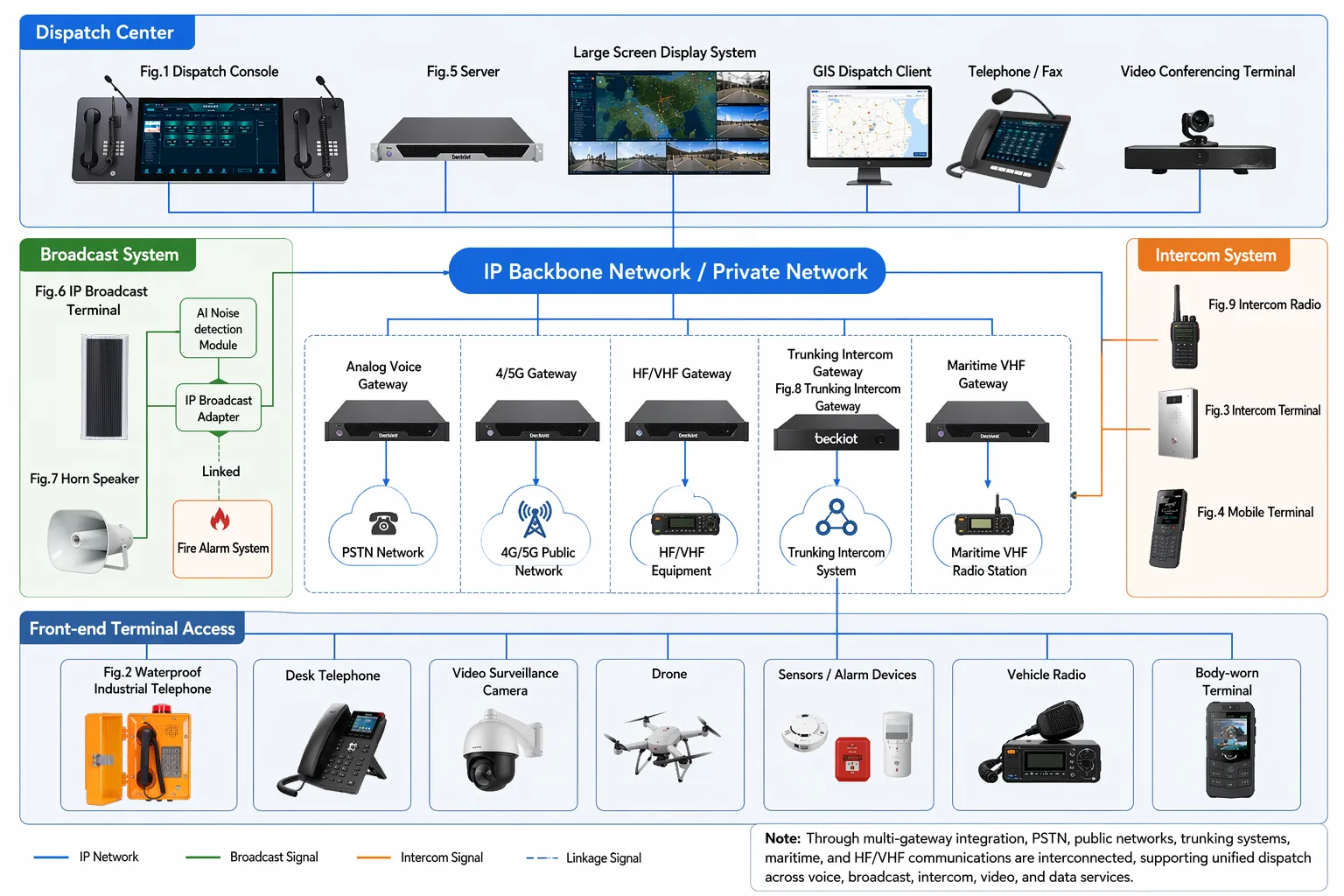
La nouvelle génération de système de commandement et de dispatching portuaire d’urgence de Becke Telcom intègre sur une seule plateforme la répartition vocale, la visioconférence, la géolocalisation SIG et le partage de données. Sur le plan horizontal, il relie les unités collaboratives : autorités portuaires et maritimes, administration maritime, services de gestion des urgences, pompiers, services médicaux et forces de sécurité publique. Sur le plan vertical, il assure la connexion avec les centres d’urgence nationaux, provinciaux, municipaux et départementaux, permettant une basculement fluide entre la supervision de sécurité quotidienne et la réponse aux incidents, et établissant une solide ligne de communication sécurisée pour les ports de jonction du cours moyen du Yangtsé.
Communication sans fil : Le réseau de regroupement numérique existant couvre 90 % du rivage, mais des zones aveugles subsistent dans les parcs à vrac et les passerelles de convoyage. Le réseau public 4G/5G repose sur une architecture de stations de base macro, vulnérable face aux intempéries convectives violentes, aux fortes pluies et aux vents violents, avec des risques d’arrêt des stations de base ou d’inclinaison des mâts, qui compromettent la continuité des communications d’urgence.
Autres communications : Les capacités de soutien aux communications d’urgence sont limitées. Les équipements actuels ne répondent qu’à une partie des besoins basiques de communication vocale et ne peuvent pas assurer la retransmission vidéo haute définition sur les lieux d’urgence ni les conférences multiparties.
Besoins internes : Douze unités de production, notamment la salle de dispatching, le pilotage, le pointage, l’exploitation des portiques, la gestion des parcs, la surveillance des zones de stockage, la supervision sécurité et environnementale et la maintenance mécanique, nécessitent une communication bidirectionnelle 24h/24 et 7j/7. Quatre canaux indépendants doivent être créés pour le commandement, les opérations, la sécurité et les interventions d’urgence, sans interférence mutuelle. Le système doit également prendre en compte le regroupement temporaire et dynamique des groupes de discussion selon les scénarios d’exploitation, pour s’adapter aux tâches variées de chargement/déchargement de vrac et d’accostage/départ des navires.
Besoins externes : Des liaisons d’appel direct en un clic doivent être établies avec des organismes tels que le bureau maritime du port de Jiujiang, la brigade anti-incendie fluviale de la branche de Jiujiang de la sécurité publique du transport fluvial du Yangtsé, l’hôpital du comté de Hukou, les services douaniers et d’inspection frontalière, avec prise en charge de la visioconférence hiérarchique. Des interfaces audio et vidéo doivent être réservées pour la connexion aux véhicules de commandement du département provincial de la gestion des urgences et au système VTS de l’administration de la sécurité maritime du Yangtsé, garantissant une coordination interrégionale fluide en cas d’urgence.
Réseau de regroupement numérique : Un nouveau système de regroupement numérique équipé de stations de base à quatre porteuses est déployé, avec une allocation dynamique des canaux pour assurer une couverture signalétique à 100 % sur l’ensemble du terminal, y compris les parcs de stockage, les quais, les passerelles et les zones de réservoirs. Le système est complété par des radios portatives, des téléphones de bureau et des terminaux fixes tels que le téléphone industriel étanche EX-BT27. Les groupes de discussion sont organisés selon quatre grands scénarios : commandement, opérations, sécurité et secours d’urgence. Le chiffrement est activé pour garantir la sécurité des échanges et empêcher l’écoute clandestine.
Véhicule de station de base mobile d’urgence : Un véhicule de communication tout-terrain personnalisé est déployé, intégrant une micro-station 5G, une station de regroupement 350 MHz et un module de réseau auto-organisé Wi-Fi 6 Mesh. Équipé d’un mât télescopique de 18 mètres et d’un groupe électrogène capable d’assurer quatre heures de fonctionnement à pleine charge, il peut restaurer la couverture du réseau public et du regroupement dans un rayon de 3 kilomètres en seulement 15 minutes après son arrivée sur site, résolvant les pannes de stations de base lors des conditions météorologiques extrêmes.
Le système est connecté au réseau de diffusion IP et aux haut-parleurs existants du terminal, complété par un module de détection de bruit IA qui ajuste automatiquement le volume de diffusion selon l’environnement sonore (bruit des parcs, klaxons des navires, etc.), garantissant une diffusion claire des consignes. Il prend en charge la diffusion zonale par quai, zone de stockage et bureau, la diffusion programmée et la synthèse vocale TTS, et peut être associé au système d’alarme incendie pour déclencher automatiquement une diffusion d’urgence dans la zone concernée en cas de sinistre.
Formation hiérarchique et par rôle : Un dispositif de formation tripartite « théorie + manipulation pratique + évaluation » est mis en œuvre. Les opérateurs de terrain se concentrent sur la manipulation des équipements de communication, la localisation rapide des pannes et le dépannage basique. Les cadres intermédiaires maîtrisent l’interprétation des plans d’urgence et les processus de coordination interservices. Les décideurs supérieurs se forment à la simulation de crises et au commandement multi-organismes, afin que chaque échelon dispose des compétences adaptées.
Mécanisme d’exercices réguliers : Des exercices « double aveugle » sans scénario préétabli sont organisés chaque trimestre pour simuler des coupures de communication dues aux intempéries violentes ou aux collisions de navires, et évaluer la capacité de basculement d’urgence du système. Un exercice interministériel complet est organisé chaque année, associant le bureau maritime du port de Jiujiang, la brigade anti-incendie fluviale et les services locaux de gestion des urgences, avec la participation d’experts provinciaux pour l’observation et l’évaluation. Un bilan est réalisé dans les 48 heures suivant l’exercice, et l’optimisation des plans d’intervention finalisée sous 72 heures, dans une logique d’amélioration continue : « chaque exercice apporte des progrès ».