

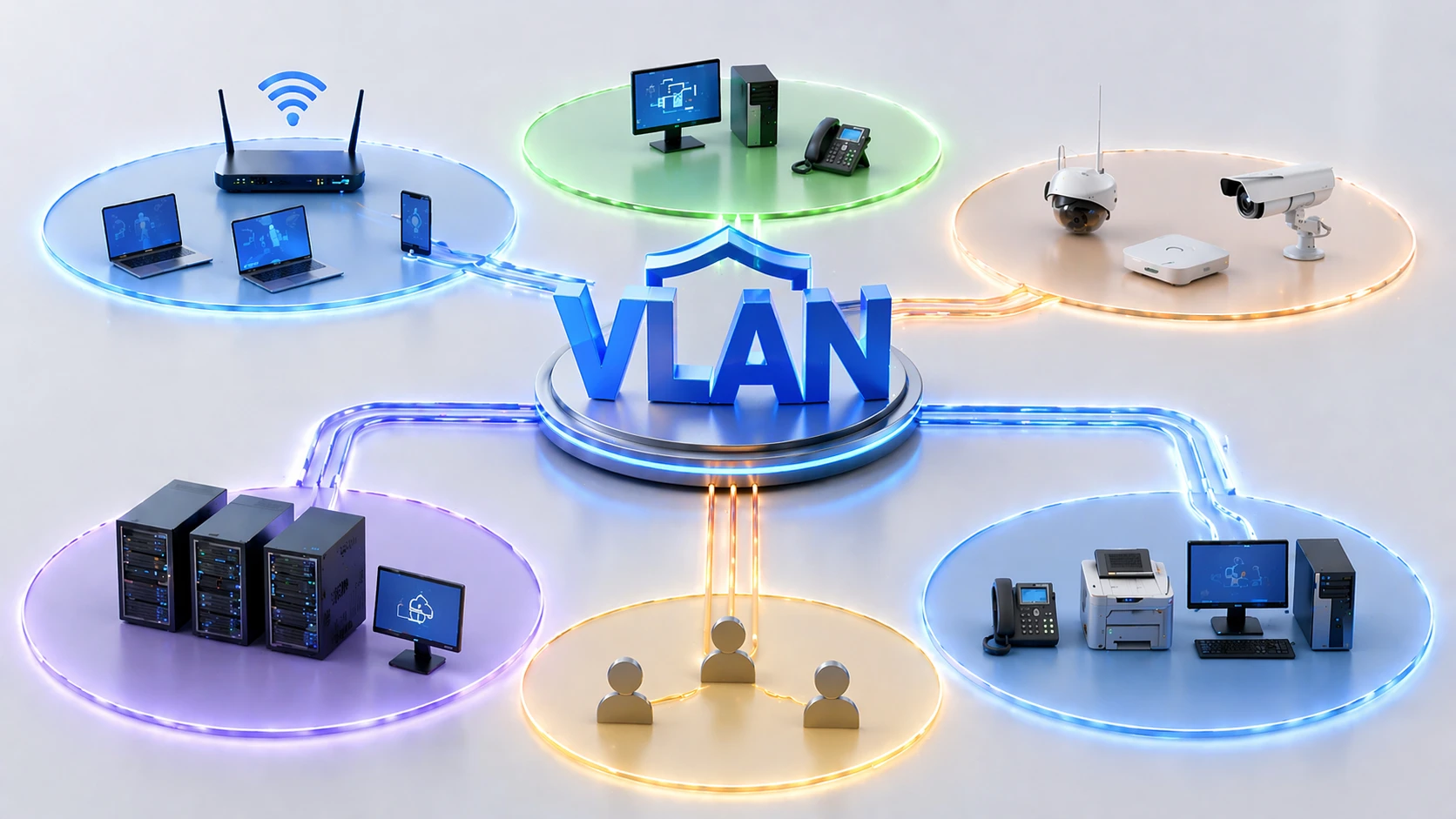
La segmentation VLAN est une méthode de conception réseau qui divise une infrastructure physique de commutation en plusieurs segments logiques. Au lieu de laisser tous les appareils connectés partager le même domaine de diffusion, les administrateurs peuvent affecter des appareils, des ports, des utilisateurs, des services, des systèmes ou des types de trafic à des LAN virtuels séparés.
Cette approche est largement utilisée dans les réseaux d’entreprise, les sites industriels, les campus, les hôpitaux, les centres de données, les chaînes de magasins, les bâtiments intelligents et les environnements de services managés. Son objectif principal est de mieux organiser le trafic, de réduire l’exposition inutile aux diffusions, de séparer les systèmes sensibles, de prendre en charge le contrôle par politiques et de simplifier l’exploitation des grands réseaux.
D’un grand LAN unique à des zones logiques contrôlées
Dans un réseau plat, de nombreux appareils se trouvent dans le même domaine de couche 2. Cela peut sembler simple au départ, mais la gestion devient difficile lorsque le nombre d’utilisateurs, d’appareils, d’applications et d’exigences de sécurité augmente. Le trafic de diffusion s’accroît, le dépannage devient plus complexe et un problème dans une zone peut affecter des systèmes sans rapport.
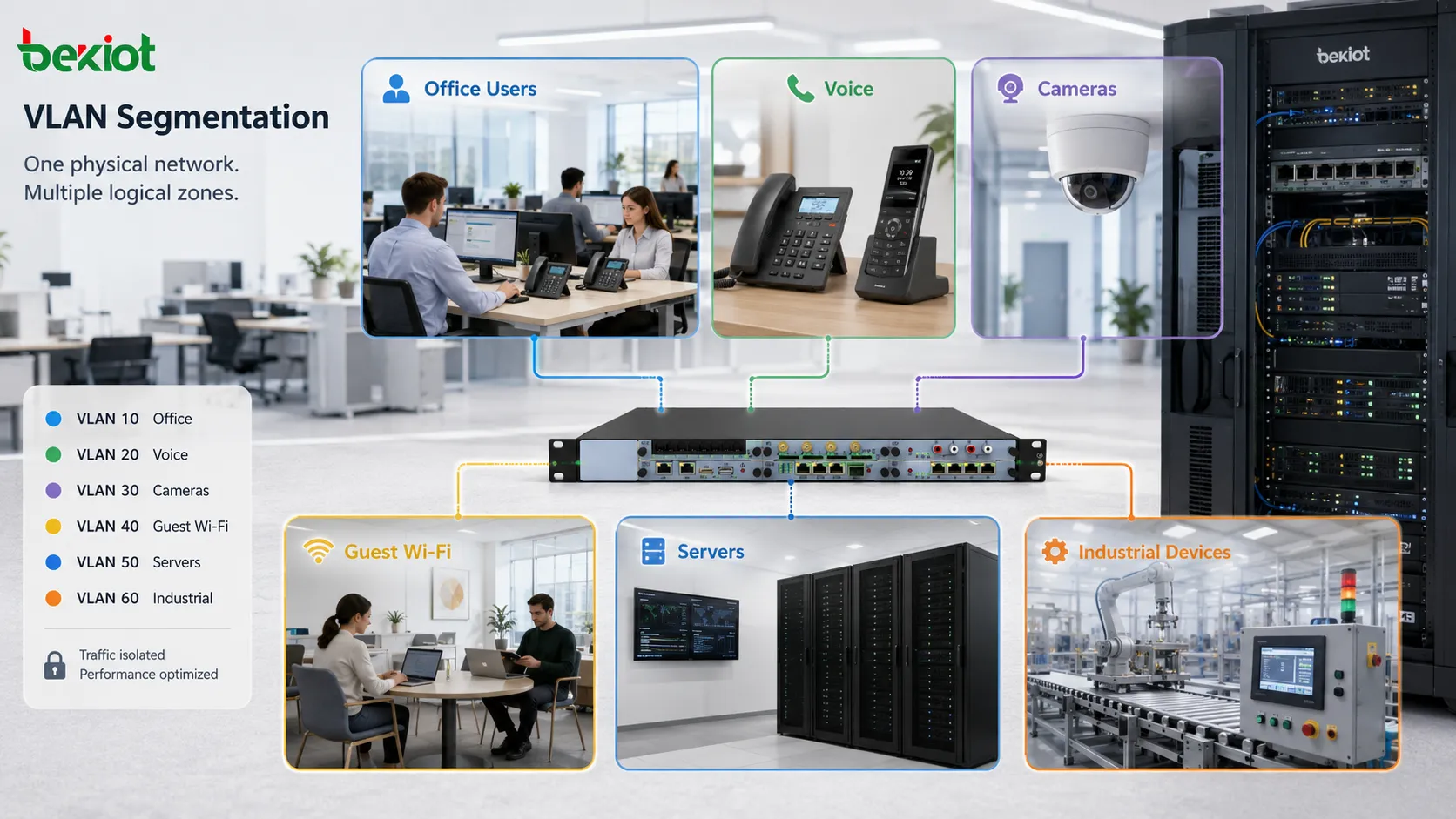
La segmentation logique modifie cette structure. Un commutateur peut transporter plusieurs réseaux virtuels distincts en même temps. Utilisateurs de bureau, téléphones IP, caméras, serveurs, Wi-Fi invité, contrôleurs industriels, interfaces de gestion et équipements de sécurité peuvent partager la même infrastructure physique tout en restant séparés par conception.
La tendance du secteur va vers des réseaux plus contrôlés et pilotés par les politiques. L’architecture zero trust, la croissance de l’IoT, la sécurité OT, le travail hybride, l’accès au cloud et la pression de conformité rendent la segmentation plus importante qu’une simple connectivité.
Mécanisme de fonctionnement de base
Affectation basée sur les ports
La conception la plus simple consiste à affecter des ports de commutateur à des segments spécifiques. Un port relié à un ordinateur de bureau peut appartenir à un réseau logique, tandis qu’un port relié à une caméra peut appartenir à un autre. Les appareils situés dans des segments différents ne peuvent pas communiquer directement en couche 2, sauf si le routage ou une politique l’autorise.
L’affectation par port est facile à comprendre et fréquente dans les environnements fixes. Elle convient aux postes de travail, caméras, imprimantes, points d’accès, équipements industriels et autres terminaux qui se déplacent rarement.
Trafic étiqueté sur les liens trunk
Lorsque le trafic de plusieurs réseaux logiques doit circuler entre des commutateurs, on utilise des liens trunk. Un trunk transporte plusieurs segments sur une seule connexion physique en ajoutant une étiquette aux trames Ethernet. Cette étiquette indique à quel réseau logique appartient la trame.
Cela permet aux commutateurs, routeurs, pare-feu, contrôleurs sans fil et serveurs de traiter correctement le trafic sans qu’un câble soit nécessaire pour chaque segment.
Liens d’accès pour les terminaux
La plupart des terminaux ordinaires se connectent via des ports d’accès. Un port d’accès appartient généralement à un seul segment et envoie du trafic non étiqueté au terminal. Le commutateur associe en interne ce trafic au segment configuré.
Cette approche garde la configuration des terminaux simple. De nombreux ordinateurs, imprimantes, caméras et téléphones n’ont pas besoin de comprendre l’étiquetage lorsque le commutateur assure la classification au niveau de l’accès.
Routage entre segments
Les appareils situés dans des zones logiques différentes ont généralement besoin d’un équipement de couche 3 pour communiquer. Il peut s’agir d’un routeur, d’un commutateur de couche 3, d’un pare-feu, d’un équipement SD-WAN ou d’une passerelle. Le routage contrôle si le trafic peut passer entre les segments.
C’est là que la politique de sécurité devient essentielle. Séparer le trafic en couche 2 n’est que la première étape. Les administrateurs doivent aussi définir quel trafic est autorisé entre les zones.
Caractéristiques clés
Contrôle du domaine de diffusion
Une caractéristique importante est le confinement des diffusions. Les paquets de broadcast restent dans leur segment attribué au lieu de se propager dans tout l’environnement de commutation.
Cela améliore l’efficacité des grands réseaux, car le trafic inutile n’atteint pas des appareils sans rapport. Cela réduit aussi le bruit que les administrateurs doivent analyser pendant le dépannage.
Isolation logique
La segmentation fournit une séparation logique entre différents groupes d’appareils ou de services. Les invités peuvent être séparés des systèmes internes. Les caméras peuvent être séparées des équipements bureautiques. Les contrôleurs industriels peuvent être séparés des ordinateurs de l’entreprise.
Cela ne remplace pas les pare-feu ni le contrôle d’accès, mais crée une structure plus propre pour appliquer les politiques.
Conception physique flexible
Les appareils n’ont pas besoin d’être séparés par des commutateurs physiques différents. Un seul commutateur administrable peut prendre en charge plusieurs réseaux logiques. Cela économise le câblage, l’espace en baie et le coût des équipements tout en maintenant la séparation.
Cette flexibilité est particulièrement utile dans les campus, les bâtiments à plusieurs étages, les usines, les entrepôts et les installations à usages mixtes.
Classification du trafic
Différents types de trafic peuvent être classés dans des zones différentes. Voix, vidéo, gestion, accès invité, systèmes de production, équipements de sécurité et trafic utilisateur peuvent être traités séparément.
Cela permet des politiques QoS plus claires, une surveillance plus simple et un comportement réseau plus prévisible.
Extension fondée sur les politiques
À mesure qu’une organisation se développe, de nouveaux services, locataires, zones de production ou types de services peuvent être ajoutés avec une numérotation et une dénomination structurées. L’extension est ainsi mieux organisée que l’ajout d’appareils dans un réseau partagé unique.
Un bon plan de nommage et de numérotation aide les administrateurs à comprendre rapidement l’objectif de chaque segment.
Valeur de sécurité dans les réseaux modernes
La sécurité est l’une des raisons les plus fortes de segmenter. Si tous les appareils sont placés dans le même réseau, un terminal compromis peut accéder plus facilement à de nombreux autres systèmes. La séparation des appareils réduit la surface d’attaque disponible.
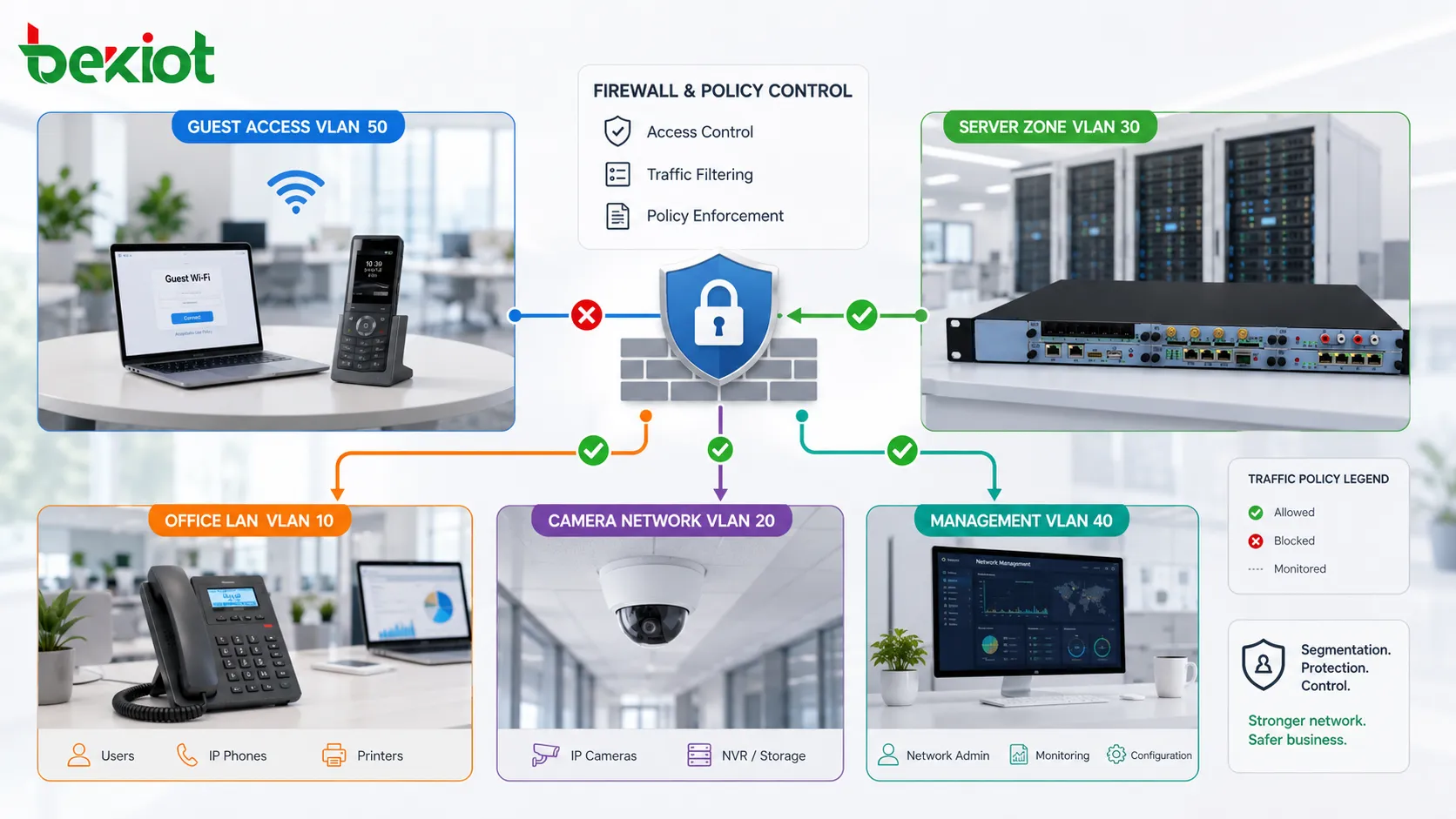
Par exemple, le Wi-Fi invité ne doit pas atteindre les serveurs internes. Les caméras IP ne doivent pas accéder librement aux systèmes financiers. Les contrôleurs d’automatisation du bâtiment ne doivent pas partager la même zone que les ordinateurs portables de bureau. Les interfaces de gestion doivent être protégées du trafic général des utilisateurs.
La segmentation soutient aussi le confinement des incidents. Si un logiciel malveillant ou un trafic suspect apparaît dans une zone, les administrateurs peuvent l’isoler, la surveiller ou la restreindre sans perturber immédiatement tout le réseau.
Performances et gestion du trafic
La segmentation peut améliorer les performances en réduisant la propagation des diffusions et en organisant les flux de trafic. Elle ne rend pas automatiquement chaque application plus rapide, mais elle crée une structure réseau plus propre où le trafic peut être contrôlé plus efficacement.
Le trafic voix peut être placé dans une zone dédiée pour prendre en charge la QoS et faciliter le dépannage. Le trafic de vidéosurveillance peut être séparé, car les flux de caméras consomment une bande passante importante. Le trafic de gestion peut être placé dans une zone restreinte afin de réduire l’exposition inutile.
En comprenant à quelle zone appartient le trafic, les administrateurs peuvent concevoir plus précisément les liaisons montantes, les chemins de routage, les règles de pare-feu, les vues de supervision et la planification de capacité.
Applications dans les bureaux d’entreprise
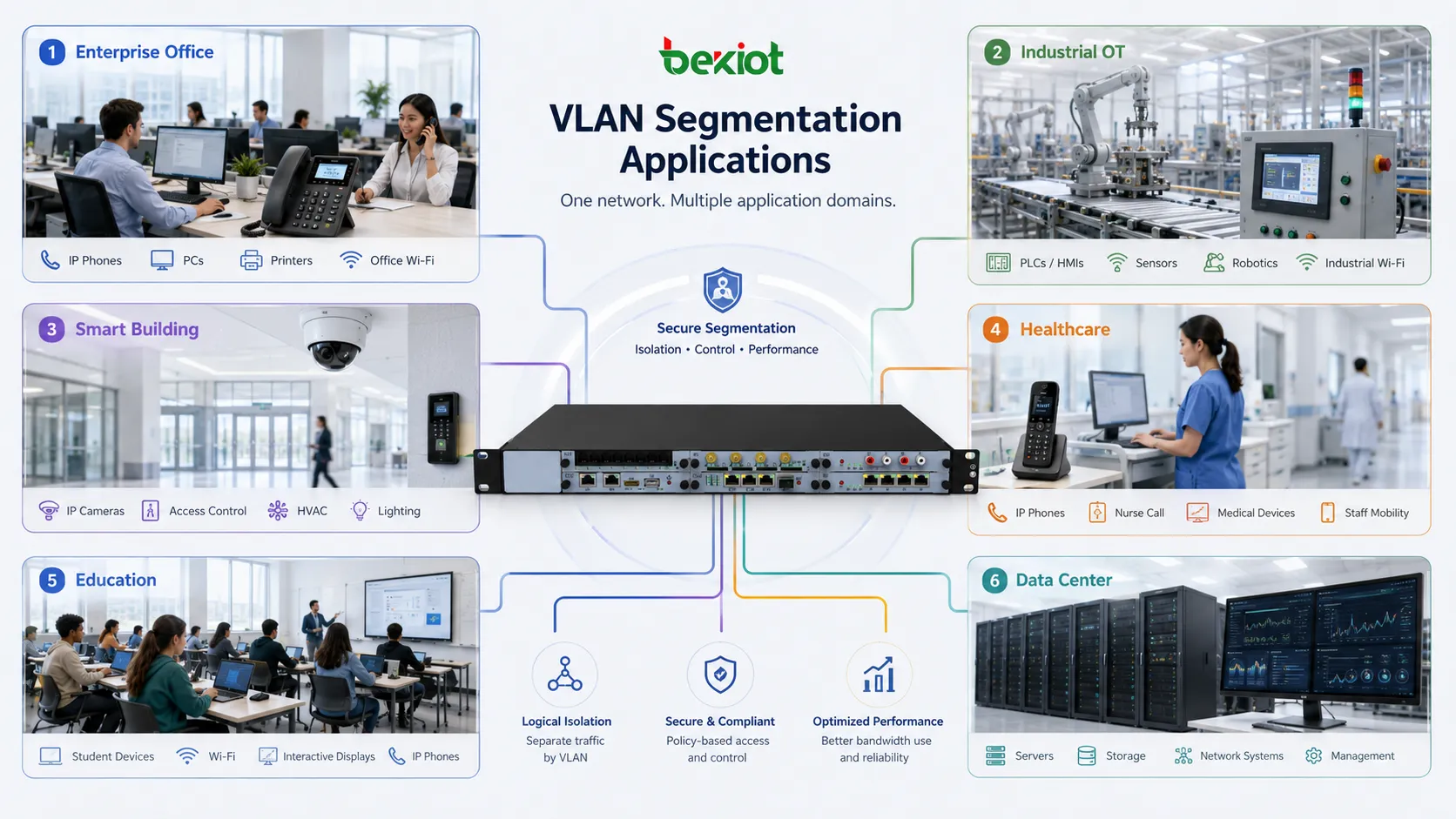
Les bureaux d’entreprise séparent souvent les services, le Wi-Fi invité, les appareils vocaux, les imprimantes, les interfaces de gestion, les caméras de sécurité et l’accès aux serveurs. Cela permet de garder le réseau organisé et de réduire les interactions inutiles entre systèmes non liés.
Dans les environnements de travail hybride, la segmentation aide aussi à séparer l’accès des employés, l’accès des prestataires, les équipements de salles de réunion, les systèmes de collaboration et les services du bâtiment.
Dans les grandes entreprises, la segmentation peut soutenir les exigences de conformité et d’audit en séparant les systèmes qui traitent des données métier sensibles du trafic bureautique ordinaire.
Applications dans les environnements industriels et OT
Les réseaux industriels peuvent comprendre des PLC, HMI, capteurs, passerelles, postes d’ingénierie, systèmes de sûreté, serveurs de production, CCTV, appareils sans fil et terminaux de maintenance. Les placer tous dans un réseau plat peut créer des risques opérationnels et de sécurité.
La segmentation logique aide à séparer les zones de production, les systèmes de contrôle, les équipements de supervision, les chemins d’accès distant et les systèmes IT de l’entreprise. Cela réduit le risque qu’un problème dans le réseau de bureau affecte les équipements de production.
Les environnements industriels exigent toutefois une planification prudente. Certains équipements anciens peuvent ne pas prendre en charge les contrôles de sécurité modernes et l’arrêt de production peut être inacceptable. La segmentation doit être testée avec les communications réelles de procédé avant un déploiement complet.
Applications dans les bâtiments intelligents
Les bâtiments intelligents contiennent de nombreux systèmes connectés, notamment contrôle d’accès, ascenseurs, HVAC, éclairage, compteurs d’énergie, parkings, appareils visiteurs, caméras de surveillance, Wi-Fi, réseaux de locataires et plateformes de gestion.
La séparation logique aide à empêcher un sous-système d’en perturber un autre. Par exemple, l’accès Internet invité ne doit pas atteindre les contrôleurs d’accès. Les caméras doivent être séparées des appareils bureautiques des locataires. Le trafic de gestion du bâtiment ne doit être visible que par les plateformes de maintenance autorisées.
Le réseau du bâtiment devient ainsi plus facile à exploiter et la posture de sécurité s’améliore à mesure que davantage d’équipements de facility deviennent basés sur IP.
Applications dans la santé et l’éducation
Les hôpitaux et établissements d’enseignement comportent souvent de nombreux types d’appareils et de groupes d’utilisateurs. Systèmes cliniques, ordinateurs administratifs, Wi-Fi invité, dispositifs médicaux, systèmes de sécurité, appareils étudiants, équipements de laboratoire et réseaux du personnel ne doivent pas partager un espace non contrôlé.
Dans la santé, la segmentation aide à protéger les systèmes sensibles et soutient une gestion plus sûre des dispositifs. Dans l’éducation, elle aide à séparer étudiants, personnel, laboratoires, accès public et services administratifs.
Ces deux environnements demandent un nommage, une documentation et une politique d’accès solides, car le nombre d’utilisateurs et d’appareils peut changer fréquemment.
Applications dans les centres de données et systèmes connectés au cloud
Les centres de données utilisent la segmentation pour séparer les niveaux applicatifs, le trafic de stockage, les réseaux de gestion, les systèmes de sauvegarde, les charges de travail de locataires et les zones de services externes. Cela crée une base structurée pour le routage, le pare-feu, la supervision et la conformité.
Les architectures connectées au cloud peuvent aussi faire correspondre les zones logiques sur site avec des groupes de sécurité cloud, des réseaux virtuels ou des politiques de pare-feu. Une logique de segmentation cohérente rend l’architecture hybride plus facile à comprendre.
À mesure que les charges de travail deviennent plus dynamiques, de nombreuses organisations combinent la segmentation traditionnelle avec les réseaux définis par logiciel, la microsegmentation et le contrôle d’accès basé sur l’identité.
Principes de conception
Définir d’abord les zones métier
Avant de configurer les commutateurs, les administrateurs doivent définir l’objectif de chaque segment. La conception doit suivre la fonction métier, le niveau de risque, le type d’appareil et le modèle de trafic plutôt qu’une numérotation aléatoire.
Les exemples incluent zone utilisateurs, zone voix, zone caméras, zone invités, zone serveurs, zone gestion, zone OT et zone de services restreints.
Utiliser un nommage et une documentation clairs
Une bonne documentation est essentielle. Chaque segment doit avoir un nom, un ID, un sous-réseau, une passerelle, un objectif, une politique de trafic autorisé, un propriétaire et une portée géographique.
Sans documentation, la segmentation devient difficile à maintenir. Les futurs ingénieurs peuvent ne pas savoir pourquoi un segment existe ni quels systèmes en dépendent.
Contrôler le routage entre zones
La segmentation est incomplète si chaque zone peut communiquer librement avec toutes les autres. Le trafic interzones doit passer par un routage contrôlé, une politique de pare-feu ou des listes de contrôle d’accès.
L’approche la plus sûre consiste à autoriser uniquement les communications nécessaires et à refuser les chemins inutiles.
Prévoir la croissance
La numérotation et l’adressage IP doivent permettre l’expansion future. Si chaque ID et sous-réseau est attribué sans structure, la montée en charge devient difficile.
Une conception planifiée permet d’ajouter plus tard de nouveaux services, agences, types d’appareils, locataires ou zones de sécurité sans refonte majeure.
Problèmes de configuration courants
Un problème courant est la mauvaise configuration des trunks. Si un segment requis n’est pas autorisé sur un trunk, les appareils peuvent perdre la connectivité. Si trop de segments sont autorisés partout, l’exposition augmente et le dépannage devient plus difficile.
Un autre problème est l’incohérence d’étiquetage. Un terminal peut envoyer du trafic étiqueté alors que le commutateur attend du trafic non étiqueté, ou un téléphone peut nécessiter un segment voix qui n’est pas annoncé correctement.
Une mauvaise configuration de la passerelle peut aussi créer des problèmes. Si la passerelle par défaut d’un segment est erronée, les appareils peuvent communiquer localement mais échouer à joindre d’autres réseaux.
Des failles de sécurité apparaissent lorsque la segmentation existe au niveau du commutateur mais que la politique de routage reste trop ouverte. Le réseau semble alors séparé, tout en permettant encore trop de communications.
Exploitation et surveillance
Après le déploiement, la surveillance doit inclure les affectations de ports, l’état des trunks, les erreurs d’interface, les niveaux de diffusion, l’utilisation des adresses IP, les plages DHCP, le trafic interzones, les journaux de pare-feu et les événements d’appareils non autorisés.
Le contrôle des changements est important. Déplacer un appareil vers le mauvais port ou attribuer le mauvais profil peut interrompre le service ou contourner la politique.
Les équipes réseau doivent aussi examiner les segments inutilisés, les règles obsolètes, les trunks non documentés et les noms incohérents. Avec le temps, une mauvaise maintenance peut transformer une conception propre en système confus.
Orientation de développement du secteur
Le secteur dépasse la séparation statique simple. De nombreuses organisations combinent la conception basée sur VLAN avec le contrôle d’accès réseau, les politiques sensibles à l’identité, la segmentation zero trust, le SDN, les groupes de sécurité cloud et le provisionnement automatisé.
La croissance de l’IoT et de l’OT pousse aussi la segmentation plus loin. Davantage de caméras, capteurs, appareils intelligents, contrôleurs et systèmes de bâtiments se connectent aux réseaux IP, et ils ne peuvent pas tous être considérés comme également fiables.
Les conceptions futures utiliseront probablement une approche en couches. Les segments logiques traditionnels resteront utiles, tandis qu’un contrôle d’accès plus fin sera ajouté par les pare-feu, le NAC, les contrôles de posture des terminaux et les politiques conscientes des applications.
Bonnes pratiques de déploiement
Commencez par un inventaire des utilisateurs, appareils, applications et flux de trafic. La segmentation doit être fondée sur ce qui doit communiquer, et non sur des hypothèses.
Créez un plan standard de nommage et de numérotation. Utilisez des libellés cohérents sur les commutateurs, routeurs, pare-feu, systèmes de gestion d’adresses IP et documents.
Séparez les appareils à haut risque ou non gérés des systèmes critiques. Accès invité, appareils IoT, caméras et contrôleurs de bâtiment ne doivent pas être placés dans la même zone que les serveurs métier ou les interfaces de gestion.
Testez les règles interzones avant la mise en production. Les applications peuvent dépendre du DNS, de l’authentification, de l’accès aux bases de données, de la journalisation, des serveurs de mise à jour ou de la synchronisation horaire, et ces dépendances doivent être autorisées intentionnellement.
Révisez régulièrement la conception. Les changements métier, nouveaux appareils, fusions, migrations cloud et incidents de sécurité peuvent exiger des mises à jour de politiques.
La segmentation VLAN est précieuse parce qu’elle transforme un environnement de commutation partagé en zones logiques organisées qui soutiennent la sécurité, les performances, la visibilité et des opérations réseau évolutives.
Questions fréquentes
La segmentation VLAN peut-elle arrêter toutes les cyberattaques ?
Non. Elle réduit l’exposition et limite les communications inutiles, mais doit être combinée avec des pare-feu, l’authentification, la surveillance, la sécurité des terminaux et le contrôle d’accès.
Chaque type d’appareil a-t-il besoin de son propre segment ?
Pas toujours. Les segments doivent être définis selon le risque, la fonction, le comportement du trafic et les besoins de gestion. Trop de segments inutiles peuvent compliquer l’exploitation.
Pourquoi deux appareils sur des segments différents ne communiquent-ils pas ?
Ils ont généralement besoin d’un routage de couche 3 et d’une politique autorisée entre leurs réseaux. Si les paramètres de routage, passerelle, pare-feu ou ACL manquent, la communication échoue.
La segmentation est-elle utile pour les petits réseaux ?
Oui, mais la conception doit rester simple. Même les petits bureaux gagnent souvent à séparer le Wi-Fi invité, les interfaces de gestion et les appareils utilisateurs internes.
Que faut-il documenter après le déploiement ?
Documentez l’ID du segment, le nom, le sous-réseau, la passerelle, l’objectif, le propriétaire, le trafic autorisé, les chemins trunk, la plage DHCP, la politique de pare-feu et les types d’appareils connectés.